
How Theben presence and daylight sensors helped cut lighting energy use by 71% at RBS Worbboden
A major lighting upgrade at a Swiss rail maintenance facility has demonstrated the measurable impact of combining efficient LED luminaires with intelligent presence and daylight control. At
the RBS Worbboden workshop, more than 80 Theben the Ronda and the Passa sensors formed
a key part of a DALI and KNX control strategy that helped reduce annual lighting energy
consumption by 71%.
For lighting specifiers and integrators, the headline figure is significant. But the detail behind it is
arguably more useful.
The results show that replacing inefficient luminaires is only part of the opportunity. Almost half
of the total energy saving achieved at Worbboden came from the lighting control itself –
highlighting the importance of sensor selection, zoning, daylight measurement and
commissioning in delivering an efficient installation.
The project at a glance
- Client: Regionalverkehr Bern-Solothurn AG
- Application: Rail maintenance workshop
- Area: More than 8,000 m²
- Existing lighting: More than 1,500 fluorescent light strips
- New lighting: 768 high-efficiency LED luminaires
- Theben products: More than 80 the Ronda and the Passa presence detectors with
daylight sensing - Control architecture: DALI and KNX, divided into 25 independently controlled sectors
- Installed lighting load: Reduced from 74.4 kW to 39.8 kW
- Overall annual lighting energy saving: 71%
A demanding environment for lighting control
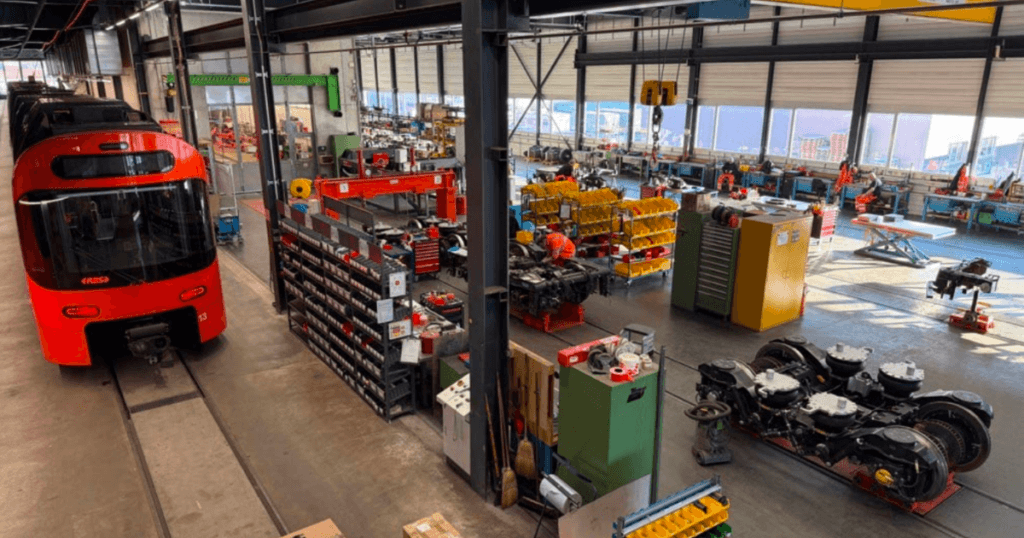
RBS Worbboden is a working rail depot where Regionalverkehr Bern-Solothurn maintains its
rolling stock. Lighting therefore has a direct role in creating safe and appropriate working
conditions across a large industrial space.
The workshop also presents the sort of conditions that make simplistic lighting control difficult.
At more than 8,000 m², different areas of the building receive very different quantities of natural
light. Occupancy changes throughout the working day and lighting needs to respond to activity
within individual sections of the facility rather than treating the complete hall as one space.
Before the refurbishment, the lighting comprised more than 1,500 36 W fluorescent light strips
with a combined connected load of 74.4 kW. Control was manual.
The refurbishment replaced these with 768 highly efficient Zumtobel Tecton LED luminaires,
reducing installed lighting power to 39.8 kW.
That change alone reduced demand. The next step was Theben presence and daylight sensing,
enabling the lighting to respond more closely to how each area of the workshop was actually
used.
Theben theRonda and thePassa at the heart of the control strategy
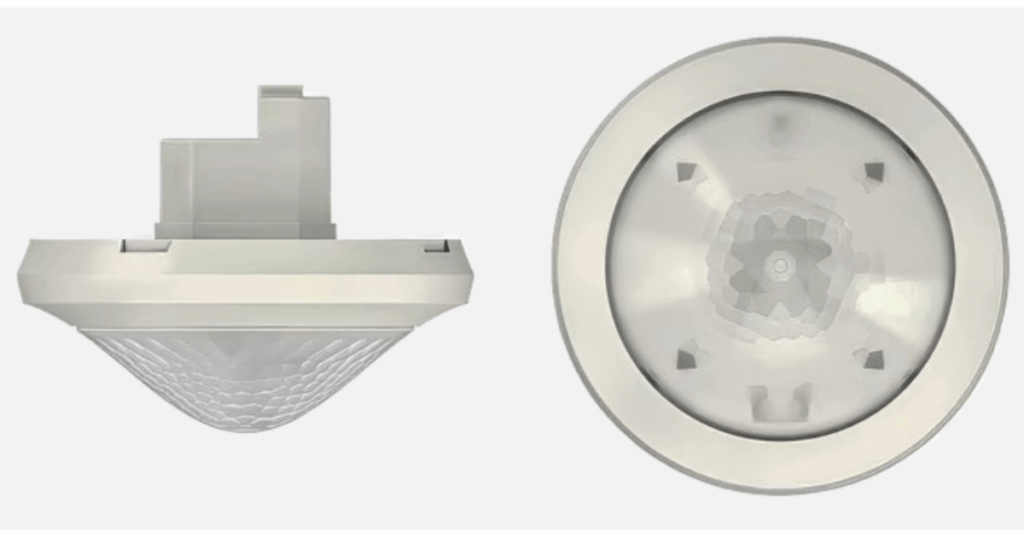
More than 80 Theben theRonda and thePassa presence detectors were installed throughout the
workshop to detect occupancy while continuously monitoring available daylight.
Because available daylight varies across the workshop, the installation was divided into 25
separate control sectors. These sectors are networked using DALI and KNX and can operate
independently.
This zoning is important.
A zone close to glazing may require very little artificial light while another part of the hall
requires considerably more at exactly the same time. Combining local presence and light
measurement from the Theben sensors with smaller control areas allows artificial lighting to
supplement natural light only where it is required.
Presence detector time delays were set to two minutes, further reducing unnecessary operating
time when areas became unoccupied.
Measuring performance in real conditions
Rather than relying solely on calculated savings, the project team monitored the completed
installation over an extended period.
Energy meters recorded the electrical consumption of the hall lighting at five-minute intervals for
around six months. Eight independent illuminance loggers also recorded light levels at different
positions within the hall and on the roof.
Combining the two datasets over more than 180 days made it possible to assess how effectively
the Theben sensor-led control strategy responded to changing occupancy and daylight
conditions across different seasons.
What did the lighting controls actually save?
The results separate the benefit of more efficient luminaires from the additional saving delivered
by intelligent control.
If the new LED installation had continued to operate manually over the same working hours as
the old fluorescent system, weekday energy consumption would already have been
approximately 47% lower.
Once the theRonda and thePassa sensors were brought into the control strategy, allowing
lighting to respond to presence and available daylight, the reduction increased further.
During a 25-working-day period between November and December, the controlled system used
58% less energy than the former fluorescent installation.
During a second 25-day period between April and May, when more natural daylight was
available, the reduction reached 74%.
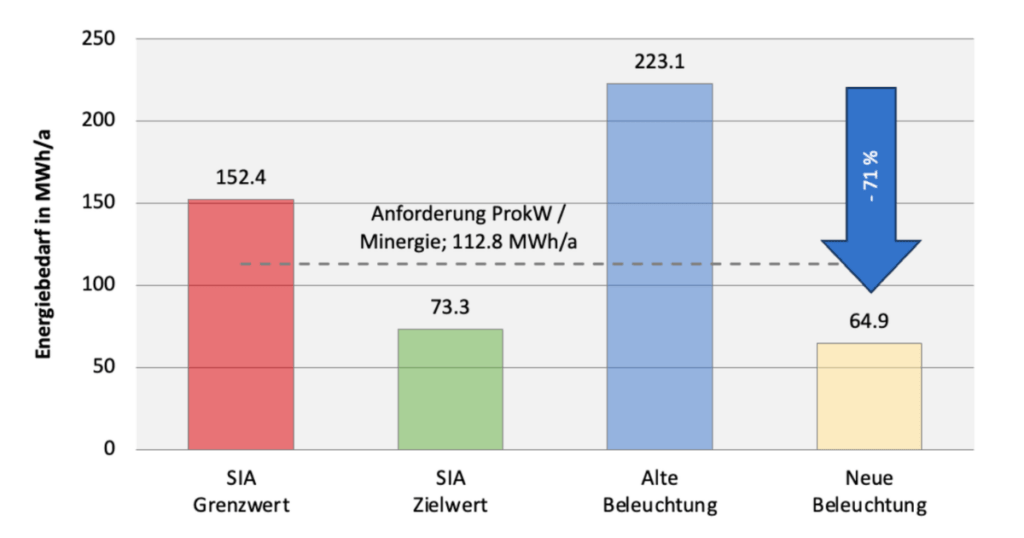
Across the annual assessment, total lighting energy savings were calculated at 71%.
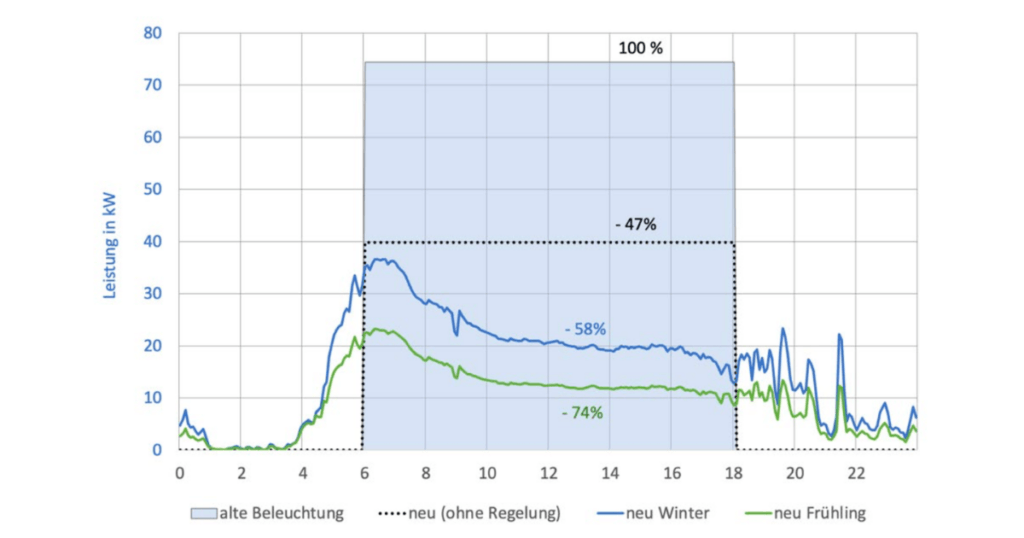
The load profiles show clearly how daylight control changes the way energy is consumed.
Instead of maintaining a fixed lighting output throughout the working day, artificial lighting
reduces progressively as natural light becomes available.
Almost half the saving came from control
Perhaps the most significant result for lighting designers and specifiers is how the overall saving
was divided.
Annual lighting consumption fell from approximately 223.1 MWh to 64.9 MWh, a reduction of
158.2 MWh.
Of this:
- approximately 78.9 MWh per year came from reducing the connected lighting load;
- approximately 78.3 MWh per year came from the lighting control strategy.
The additional saving provided by presence and daylight control was therefore almost equal to
that achieved by replacing the fluorescent lighting with high-efficiency LEDs.
It is a useful reminder that luminaire efficacy is only one part of lighting energy performance.
The right sensor technology and control strategy determine how long luminaires operate, where
they operate and at what output.
Benchmarking the installation
The project was also evaluated against SIA Standard 387/4, the Swiss standard for electrical
energy used by lighting in buildings.
The completed system achieved an installed power of 4.9 W/m², significantly below the SIA
target value of 6.6 W/m². This was supported by luminaire efficiency of around 170 lm/W.
Measured full-load hours were 1,631 hours per year, compared with the SIA target of 1,364
hours.
Although SIA 387/4 is a Swiss rather than UK compliance standard, the comparison provides a
useful technical benchmark. It also shows that even after achieving a 71% reduction, there
remained some opportunity to refine the control strategy further.
Getting the most from presence and daylight detection
The Worbboden results reinforce an important point: installing a presence detector with light
measurement does not automatically deliver the full energy-saving potential.
Detection areas, sensor positioning, switching groups, target illuminance levels and delay times
all affect performance.
Oversized zones, for example, can result in artificial lighting being maintained across a large
area because one part of that zone requires additional light. Poorly calibrated daylight
thresholds can have a similar effect.
At Worbboden, the combination of more than 80 Theben theRonda and thePassa sensors, 25
independently controlled sectors and DALI/KNX networking allowed lighting output to respond
much more closely to conditions within individual areas of the hall.
What the project demonstrates
The RBS Worbboden project provides measured evidence that efficient luminaires and
intelligent control should be considered as one lighting strategy rather than two separate
measures.
High-efficiency LEDs significantly reduced the base electrical load. Theben theRonda and
thePassa presence detectors then provided the occupancy and daylight information needed for
the control system to reduce unnecessary operating hours and adapt artificial light to actual
conditions.
The result was a 71% annual reduction in lighting energy consumption in a demanding industrial
environment – with almost half of the total saving attributable to control.
For lighting designers, consultants and system integrators, the message is clear: sensor
selection, positioning, zoning and commissioning deserve the same attention as luminaire
selection. Efficient luminaires cut energy while operating; intelligent sensing and control
determine when, where and at what level they operate.