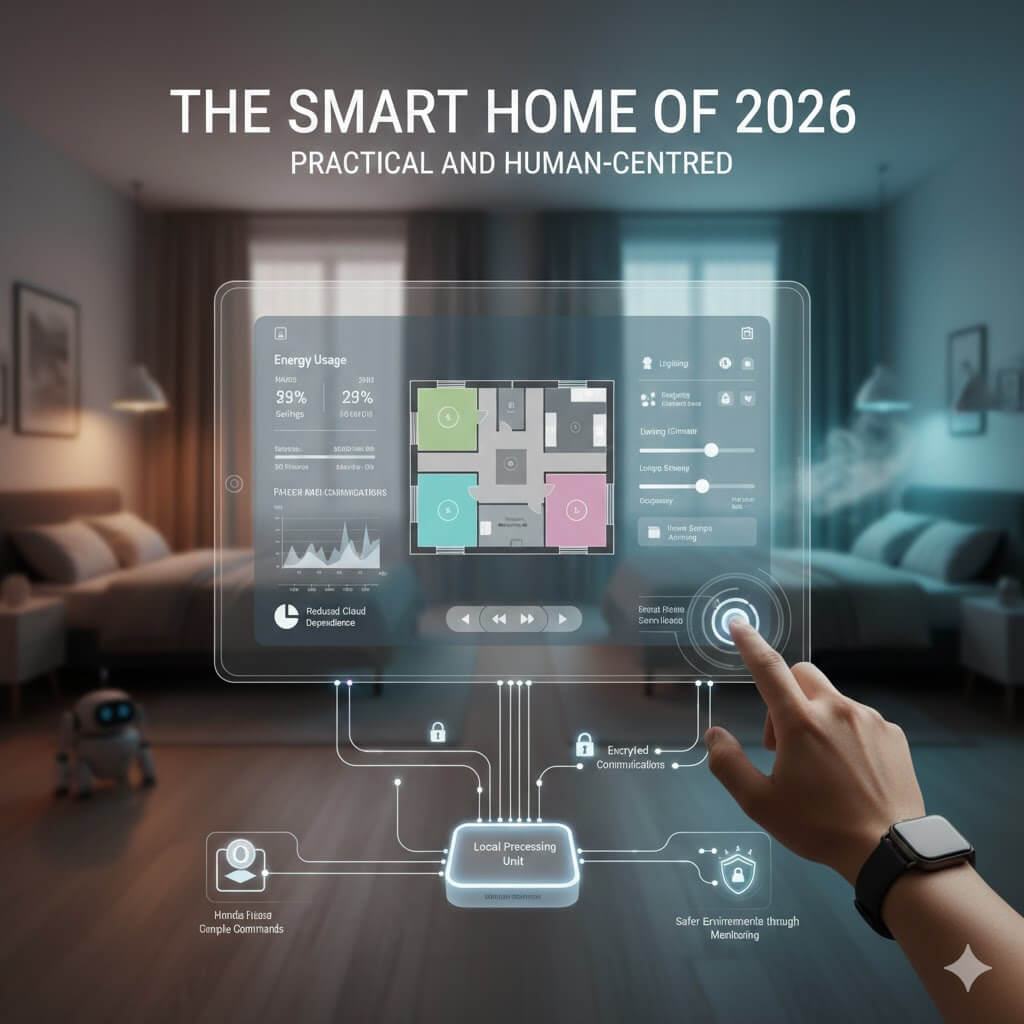
Smart home technology has moved out of the novelty phase and into everyday life. What was once seen as a luxury or a tech experiment is now becoming a practical solution to real-world problems faced by homeowners across the UK. Rising energy costs, changing lifestyles, increased time spent at home, and a growing focus on sustainability are all shaping how people think about their living spaces.
As we approach 2026, the Smart Home in UK market is evolving rapidly. The emphasis is no longer on flashy gadgets or isolated devices. Instead, it is on systems that are reliable, intuitive, energy-efficient, and designed to work seamlessly in the background. Homeowners want technology that improves comfort, reduces costs, and simplifies daily routines without adding complexity.
This article explores the future of smart homes in the UK, highlighting the key trends to watch in 2026. It explains how smart home control systems are changing, what homeowners should prioritise, and how the next generation of smart homes will focus more on usability and long-term value than on novelty.
Why Smart Homes Are Becoming Mainstream in the UK
Smart home adoption in the UK has accelerated for several reasons. One of the most significant drivers is cost. Energy prices remain unpredictable, and homeowners are increasingly looking for ways to manage consumption more effectively. Smart heating, lighting, and energy monitoring systems offer practical solutions rather than theoretical savings.
Lifestyle changes are also playing a role. Remote and hybrid working have become normal for many households. Homes now need to support work, relaxation, family life, and entertainment all in the same space. Smart home systems help adapt environments to different needs throughout the day.
At the same time, technology itself has matured. Early smart home products often felt unreliable or difficult to use. Devices failed to communicate properly. Apps were cluttered and inconsistent. These issues discouraged long-term adoption. By 2026, many of these problems have been addressed through better integration, improved standards, and more thoughtful design.
What Defines a Smart Home in 2026
In 2026, a smart home is defined less by the number of devices and more by how intelligently those devices work together. A truly smart home does not require constant interaction or manual control. It anticipates needs, responds to changes, and supports daily life quietly and efficiently.
Key characteristics of a modern smart home include: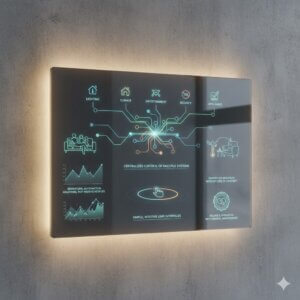
- Centralised control of multiple systems
- Automation based on behaviour, not rigid schedules
- Energy optimisation without loss of comfort
- Simple, intuitive user interfaces
- Reliable operation with minimal maintenance
The focus has shifted from “smart features” to “smart outcomes”.
The 5 W’s of Smart Homes in the UK
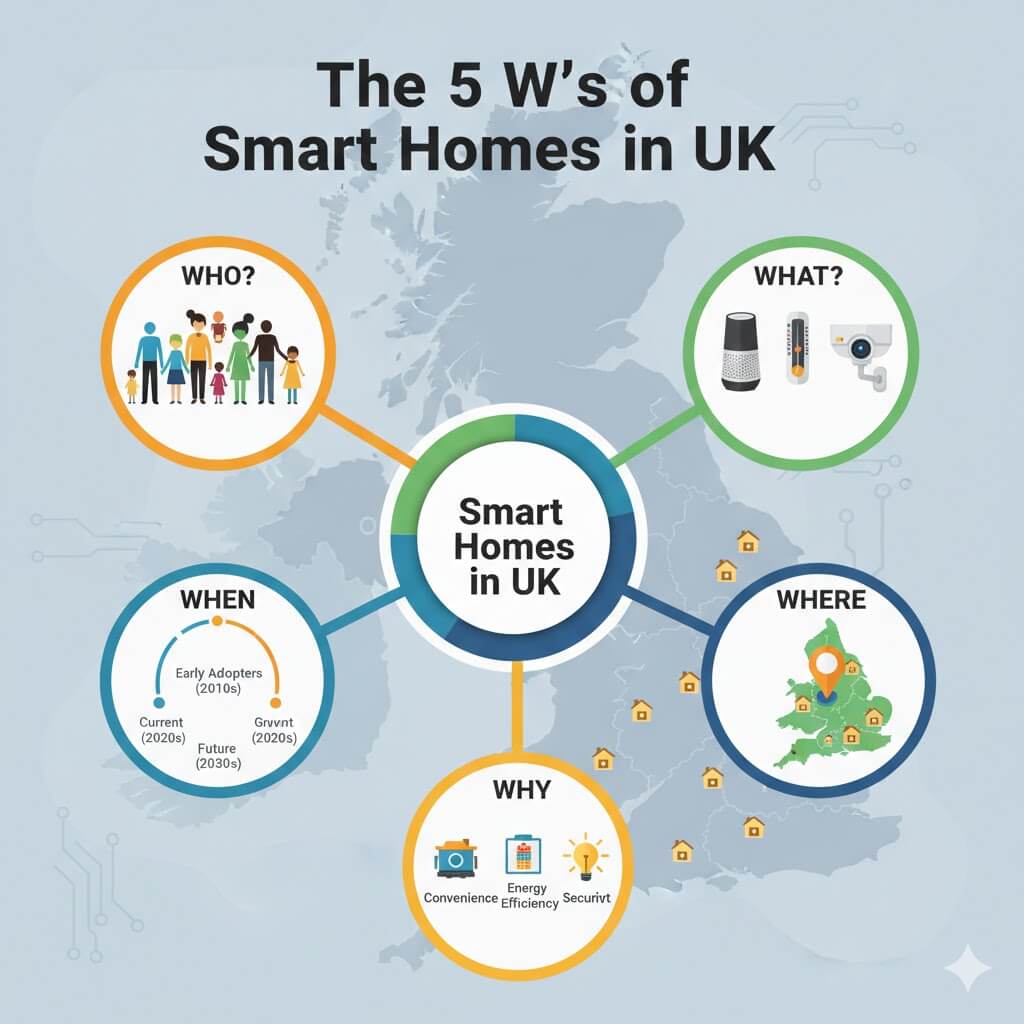
Who Is Driving Smart Home Adoption?
Smart homes are no longer limited to tech enthusiasts or high-end properties. Adoption is being driven by a wide range of homeowners, including:
- Families seeking lower energy bills
- Professionals wanting convenience and flexibility
- Home renovators future-proofing properties
- Older homeowners interested in safety and accessibility
The audience for smart homes is broadening rapidly.
What Are Smart Homes Used For Most?
By 2026, the most common uses of smart home systems in the UK include:
- Intelligent heating and climate control
- Automated lighting for comfort and efficiency
- Enhanced home security and monitoring
- Simplified control of multiple systems
- Support for daily routines and wellbeing
Entertainment still matters, but it is no longer the primary focus.
Where Are Smart Homes Being Installed?
Smart home systems are increasingly common in:
- New-build homes
- Renovation and extension projects
- Apartments and smaller properties
- Multi-room family homes
Importantly, smart homes are not limited to large or expensive houses.
Why Are Smart Homes Becoming Essential?
The main reasons include:
- Rising energy costs
- Sustainability and carbon reduction goals
- Increased time spent at home
- Higher expectations for comfort and control
Smart homes help manage these challenges more effectively.
When Is the Best Time to Invest?
While new builds and renovations offer ideal opportunities, modular systems mean homeowners can start small at any time and expand gradually. Smart homes are no longer all-or-nothing projects.
Trend 1: Energy Efficiency as the Core of Smart Homes
Energy management is the single most important smart home trend heading into 2026.
In the UK, energy efficiency is no longer a “nice to have”. It is a necessity. Smart homes are increasingly designed to actively reduce consumption while maintaining comfort.
Key developments include: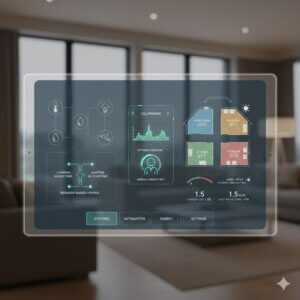
- Heating systems that learn household patterns
- Zoned heating with room-by-room control
- Lighting that adjusts based on daylight and occupancy
- Real-time energy monitoring and feedback
For the Smart Home in UK, energy efficiency is the foundation on which everything else is built.
Why This Trend Matters
Traditional heating systems rely on fixed schedules that rarely match real life. Smart systems respond dynamically, heating rooms only when needed and reducing waste automatically.
This results in lower bills, reduced carbon impact, and improved comfort.
Addressing Concerns About Automation
Some homeowners worry about losing control. Modern systems address this by combining automation with easy manual overrides. Users remain in control without needing to manage everything constantly.
Trend 2: Centralised and Unified Smart Home Control
One of the biggest frustrations of early smart homes was fragmentation. Each device had its own app. Systems did not integrate properly. Managing the home felt more complicated, not less.
By 2026, unified smart home control systems are becoming the standard.
These systems bring together: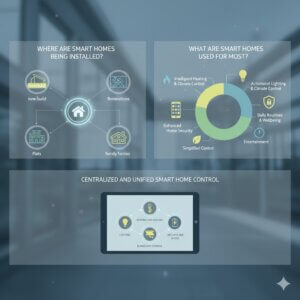
- Lighting
- Heating and cooling
- Blinds and shading
- Security and access
- Energy monitoring
All controlled through a single, consistent interface.
Why Unified Control Is a Game Changer
A smart home should be accessible to everyone in the household. Unified control reduces confusion and ensures that technology enhances daily life instead of getting in the way.
This is especially important in family homes and shared living spaces.
The Trade-Offs
Unified systems often require more upfront planning and professional installation. However, they deliver far greater reliability and usability over time, making them a better long-term investment.
Trend 3: Behaviour-Based Automation
In 2026, smart homes are moving beyond rigid schedules. Automation is increasingly based on real behaviour rather than predefined rules.
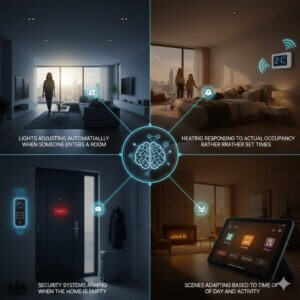 Examples include:
- Lights adjusting automatically when someone enters a room
- Heating responding to actual occupancy rather than set times
- Security systems arming when the home is empty
- Scenes adapting based on time of day and activity
The home becomes responsive rather than prescriptive.
Why This Approach Works Better
People do not live according to perfect schedules. Behaviour-based automation reflects real life, making smart homes feel natural and intuitive.
This increases satisfaction and long-term use.
Privacy Considerations
Behaviour-based systems raise understandable privacy concerns. Reputable smart home solutions prioritise local processing and minimise data sharing, giving homeowners greater control over their information.
Trend 4: Simplicity and Better User Experience
Ease of use is one of the most important smart home trends for 2026.
Manufacturers and integrators are focusing on: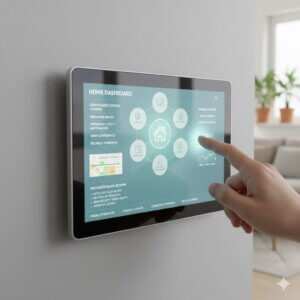
- Clear, visual interfaces
- Logical layouts
- Consistent controls across devices
- Reduced reliance on technical language
Smart homes are becoming easier for people of all ages to use confidently.
Why Simplicity Is Critical
A smart home is a shared environment. Systems must work for everyone, not just the most technically confident person in the household.
Simplicity drives adoption and reduces frustration.
Balancing Power and Ease of Use
Advanced features still exist, but they are presented in a way that does not overwhelm users. Power is available when needed, without being intrusive.
Trend 5: Reliability and Stability Over Novelty
As smart homes mature, reliability is becoming more important than adding new features.
Homeowners expect smart systems to work consistently, even during internet outages or network issues.
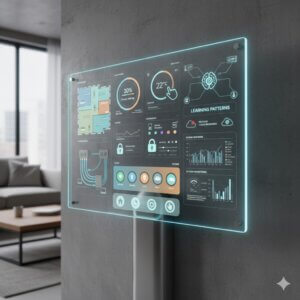 Developments include:
- More local processing
- Reduced reliance on cloud services
- Hybrid wired and wireless systems
- Improved system monitoring
Reliability is now a baseline expectation.
Why Reliability Builds Trust
A smart home that fails regularly quickly loses credibility. Lighting, heating, and security systems must work every time.
Reliability encourages homeowners to rely on automation rather than bypass it.
Trend 6: Smart Homes Integrated Into Home Design
Smart home technology is increasingly considered during the design stage rather than added later.
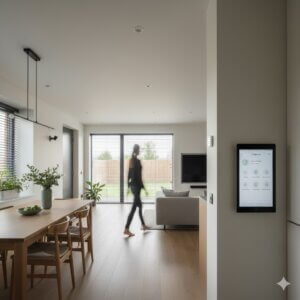 In 2026, smart systems are being integrated into:
- Electrical and lighting plans
- Heating and ventilation systems
- Interior layouts
- Renovation and extension projects
This leads to cleaner installations and better overall performance.
The Benefits of Early Planning
Design-led smart homes are easier to use, easier to maintain, and more visually cohesive. Early planning reduces disruption and future retrofitting costs.
Accessibility and Inclusive Design
Smart homes are also supporting accessibility, helping people remain independent for longer and making homes more inclusive.
Trend 7: Security and Privacy by Design
As connectivity increases, so does the importance of security.
Homeowners in the UK are increasingly aware of data protection and cyber security. Smart home systems in 2026 are responding with stronger, built-in protections.
 These include:
- Encrypted communications
- Local data storage
- Clear permission controls
- Reduced dependence on third-party services
Security is becoming a fundamental design principle.
Building Trust Through Transparency
Homeowners want to know how their data is used. Systems that offer transparency and control are gaining trust and popularity.
Trend 8: Modular and Scalable Smart Home Systems
Flexibility is another defining trend.
Many homeowners want to start small and expand over time. Modular smart home systems make this possible.
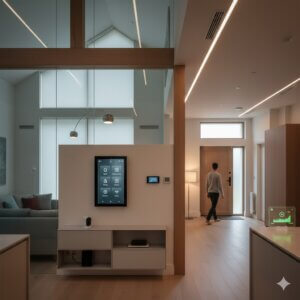
Typical approaches include:
- Starting with heating or lighting
- Adding security later
- Expanding automation gradually
This reduces upfront cost and complexity.
Why Scalability Matters
Life changes. Homes change. Modular systems allow smart homes to evolve alongside homeowners rather than becoming obsolete.
Trend 9: Voice Control as a Supporting Feature
Voice control remains useful, but its role is changing.
In 2026, voice assistants work best as a supplement rather than the primary control method. They are 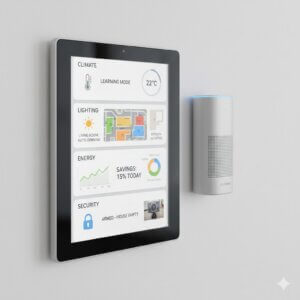 particularly helpful for:
- Simple commands
- Accessibility
- Hands-free use
However, they are no longer the centrepiece of smart homes.
Trend 10: Smart Homes Supporting Health and Wellbeing
Wellbeing is becoming an important focus in smart home design.
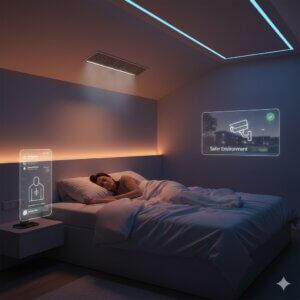 Smart homes are increasingly supporting:
- Better sleep through adaptive lighting
- Improved comfort through climate optimisation
- Reduced stress through automation
- Safer environments through monitoring
The home becomes an active contributor to wellbeing.
Are Smart Homes Right for Everyone?
Smart homes are not a one-size-fits-all solution. Some people prefer minimal automation. Others are concerned about cost or complexity.
These concerns are valid. The key is thoughtful design and realistic expectations. A smart home should enhance life, not dictate it.
What to Prioritise When Planning a Smart Home in the UK
For homeowners considering a Smart Home in UK, the most important priorities for 2026 are:
- Energy efficiency
- Unified control
- Reliability
- Ease of use
- Scalability
Focusing on these areas delivers the greatest long-term value.
When Professional Guidance Makes Sense
While DIY solutions exist, professional design and installation are valuable when:
- Integrating multiple systems
- Renovating or building
- Prioritising long-term reliability
- Designing for future expansion
Expert guidance reduces mistakes and improves outcomes.
Final Thoughts: The Smart Home of 2026 Is Practical and Human-Centred
The future of smart homes is not about showing off technology. It is about creating homes that work better for the people living in them.
By 2026, smart homes in the UK are becoming quieter, simpler, and more supportive. Technology fades into the background, allowing comfort, efficiency, and wellbeing to take centre stage.
For anyone exploring the future of the Smart Home in UK, the message is clear: the smartest homes are not the most complex. They are the ones that feel effortless to live in.
When implemented thoughtfully, smart home systems do not just keep up with the future. They help shape a better way of living.