

Lighting is one of the most powerful yet underused tools in commercial building design. It influences how people feel in a space, how safely and efficiently they can work, and how much energy a building consumes day after day. Despite this, many commercial spaces still rely on outdated lighting systems that are inefficient, inflexible, and expensive to run.
Modern commercial buildings need lighting that does more than illuminate. They need lighting that adapts to how spaces are used, responds automatically to occupancy and daylight, integrates with other building systems, and delivers long-term efficiency without adding operational complexity.
This is where intelligent lighting comes in.
If you are researching lighting control systems UK, this guide explains how to design an intelligent lighting setup that genuinely works harder for commercial environments. Rather than focusing on products or manufacturers, it focuses on design principles that apply across offices, retail spaces, warehouses, education buildings, healthcare facilities, and mixed-use developments.
Below are five practical, proven tips to help you design intelligent lighting that improves comfort, reduces energy use, and delivers lasting value.
What Is Intelligent Lighting?
Intelligent lighting refers to lighting systems that automatically adapt to their environment and usage. Instead of relying on fixed schedules or manual switches, intelligent lighting uses sensors, automation, and digital control to deliver the right light at the right time.
An intelligent lighting setup typically includes:
- Digital lighting control rather than fixed wiring
- Occupancy or presence sensors
- Daylight-responsive dimming
- Zoned lighting layouts
- Scene-based control
- Integration with wider building systems
The goal is not complexity. The goal is efficiency, consistency, and ease of use.
Why Intelligent Lighting Is Critical in Commercial Spaces
Commercial buildings face challenges that residential spaces do not. They often operate for long hours, experience fluctuating occupancy, and include a wide variety of space types under one roof.
Without intelligent lighting, this often leads to:
- Lights being left on unnecessarily
- Poor lighting quality in some areas
- Increased energy costs
- Higher maintenance requirements
- Frustrated occupants
Intelligent lighting addresses these issues by automating decisions that humans are unlikely to make consistently.
The 5 W’s of Intelligent Lighting Design
Who Benefits from Intelligent Lighting?
Intelligent lighting benefits:
- Business owners and tenants
- Facilities and energy managers
- Employees and staff
- Customers, visitors, and occupants
Anyone who uses or manages a commercial space benefits from better lighting.
What Makes a Lighting System Intelligent?
A lighting system becomes intelligent when it can:
- Sense occupancy
- Respond to daylight levels
- Adjust automatically to time and activity
- Provide feedback and data
It is not about touchscreens or apps. It is about responsive behaviour.
Where Is Intelligent Lighting Most Effective?
Intelligent lighting is especially valuable in:
- Offices and workspaces
- Retail environments
- Warehouses and distribution centres
- Schools, colleges, and universities
- Hospitals and care facilities
Any space with variable usage patterns can benefit.
Why Are Businesses Investing in Intelligent Lighting?
The main drivers include:
- Energy efficiency and cost control
- Sustainability targets
- Better comfort and wellbeing
- Compliance with regulations
- Smarter building operation
Lighting is one of the easiest systems to optimise.
When Should Intelligent Lighting Be Designed?
The best results come when intelligent lighting is considered during:
- New builds
- Refurbishments
- Office fit-outs
- Space reconfigurations
That said, many modern lighting control systems UK are well suited to retrofitting existing buildings.
Tip 1: Design Lighting Around Real Usage, Not Assumptions
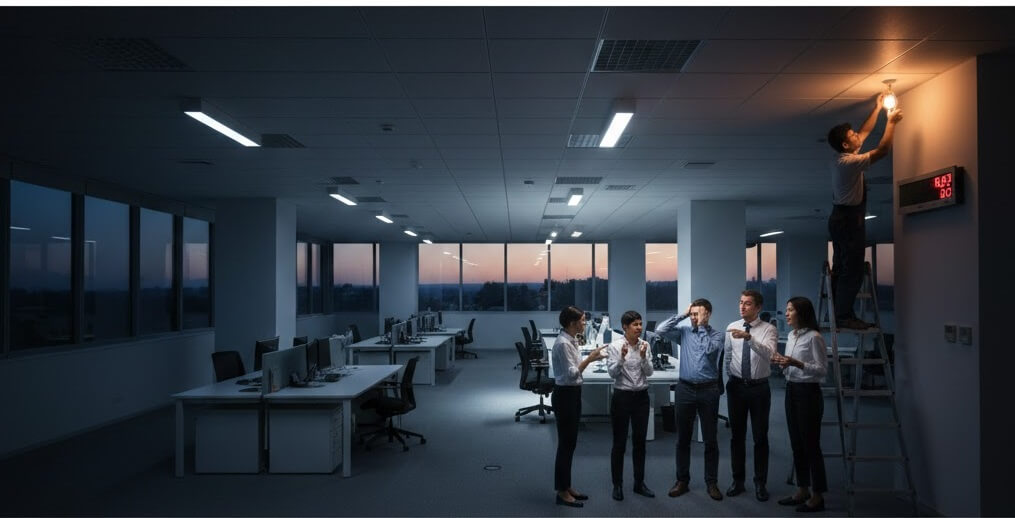
The foundation of intelligent lighting design is understanding how spaces are actually used.
Too many lighting systems are designed based on floor plans rather than behaviour. This leads to inefficient automation and user frustration.
Analyse Occupancy Patterns
Before designing the system, consider:
- Which spaces are occupied constantly
- Which are used intermittently
- Peak usage times
- Quiet or low-occupancy periods
Meeting rooms, corridors, storage areas, and breakout spaces all behave very differently and should be treated accordingly.
Match Light Levels to Activities
Different tasks require different lighting conditions.
Examples include:
- High, consistent light levels for focused work
- Softer lighting for breakout and waiting areas
- Bright, uniform lighting for circulation spaces
- Adjustable lighting for multi-purpose rooms
Designing lighting behaviour around activity improves comfort and efficiency.
Why This Tip Matters
When lighting reflects real usage, automation feels natural rather than disruptive. Lights behave as people expect them to, without constant manual correction.
This is the difference between lighting that feels intelligent and lighting that feels annoying.
Tip 2: Use Sensors Strategically, Not Aggressively

Sensors are essential to intelligent lighting, but more sensors do not automatically mean better results.
Poor sensor placement or configuration is one of the most common causes of dissatisfaction with automated lighting.
Presence and Occupancy Sensors
Presence sensors detect when a space is occupied. They are ideal for areas with intermittent use, such as:
- Meeting rooms
- Toilets
- Storage areas
- Corridors and stairwells
Lights should turn on smoothly when someone enters and turn off after an appropriate delay when the space is empty.
Daylight Sensors
Daylight sensors measure the amount of natural light entering a space. They allow artificial lighting to dim automatically when daylight is sufficient.
This is especially effective:
- Near windows
- In atriums
- In glazed office spaces
Daylight control improves comfort while significantly reducing energy consumption.
Avoid Over-Sensitivity
Overly sensitive sensors can cause lights to flicker, switch off unexpectedly, or behave inconsistently.
Intelligent lighting prioritises smooth transitions and predictable behaviour over aggressive energy saving.
Tip 3: Think in Zones and Scenes, Not Switches

Traditional lighting design revolves around switches and circuits. Intelligent lighting design revolves around zones and scenes.
This shift is critical.
What Is Lighting Zoning?
Zoning groups lights based on how a space is used rather than how it is wired.
For example:
- Desk areas as one zone
- Walkways as another
- Feature or accent lighting as a third
Zones can overlap and be reconfigured without rewiring.
What Are Lighting Scenes?
Scenes define how multiple zones behave together.
Common scenes include:
- Working hours
- Presentation mode
- Cleaning mode
- After-hours security lighting
With one command, an entire space can change its lighting behaviour.
Why Zones and Scenes Are So Powerful
Zones and scenes provide flexibility. As layouts change or businesses grow, lighting can adapt through software rather than costly physical changes.
This is one of the biggest long-term advantages of modern lighting control systems UK.
Tip 4: Integrate Lighting with Other Building Systems

Lighting works best when it is part of a wider building ecosystem.
In intelligent commercial buildings, lighting should share data and logic with other systems rather than operating in isolation.
Benefits of Integration
Integration allows systems to respond more intelligently to real-world conditions.
Examples include:
- Lighting responding to access control events
- Heating and lighting coordinated by occupancy
- Security systems triggering lighting scenes
- Energy platforms monitoring lighting usage
This creates a more cohesive and efficient building.
Common Integration Platforms
Lighting control is often integrated with:
- Building management systems
- Automation standards such as KNX
- Energy monitoring systems
This allows lighting to contribute to overall building performance.
Plan Integration Early
Integration is most effective when planned at the design stage. Early planning reduces cost, complexity, and future limitations.
Tip 5: Prioritise Reliability, Simplicity, and Longevity

An intelligent lighting system should reduce operational effort, not increase it.
Systems that are unreliable or overly complex quickly lose trust and are often bypassed by users.
Choose Proven, Open Technologies
Commercial lighting is a long-term investment. Choose systems that offer:
- Open standards
- Multi-manufacturer compatibility
- Long product lifecycles
- Professional certification
This reduces the risk of obsolescence.
Keep Controls Simple for Users
Most users want lighting to “just work”.
Effective systems provide:
- Clear, intuitive controls
- Minimal need for manual adjustment
- Predictable behaviour
The intelligence should stay behind the scenes.
Design for Change
Commercial spaces evolve over time. Intelligent lighting systems should be easy to adapt as layouts, tenants, or usage patterns change.
Flexibility protects your investment.
The Case For and Against Intelligent Lighting
The Benefits
- Significant reductions in energy consumption
- Improved comfort and productivity
- Lower maintenance and operational costs
Common Concerns
- Higher upfront investment
- Fear of complexity
- Worries about unreliable automation
The Reality
Most issues arise from poor design, not the technology itself. When designed properly, intelligent lighting delivers strong long-term returns.
Common Mistakes to Avoid
Many intelligent lighting projects fail due to avoidable errors, including:
- Designing without understanding usage
- Poor sensor placement
- Over-automation
- Lack of system integration
- No maintenance strategy
Avoiding these mistakes is critical to success.
Intelligent Lighting Across Different Commercial Spaces
Offices
Benefits include:
- Better focus and productivity
- Reduced energy use
- Flexible layouts
Retail Spaces
Benefits include:
- Enhanced customer experience
- Adaptive lighting throughout the day
- Highlighting products effectively
Warehouses and Logistics
Benefits include:
- Major energy savings
- Improved safety
- Fully automated operation
Education and Healthcare
Benefits include:
- Comfort and wellbeing
- Reliable, consistent lighting
- Compliance with standards
Measuring the Success of Intelligent Lighting
Success should be measured beyond installation.
Key indicators include:
- Reduced energy bills
- Improved user satisfaction
- Fewer manual overrides
- Lower maintenance requirements
Data and feedback are essential for optimisation.
When to Involve Lighting Control Specialists
While some decisions can be made internally, professional input is invaluable for:
- Complex layouts
- Sensor-based automation
- System integration
- Regulatory compliance
Experienced specialists help avoid costly mistakes.
The Growing Role of Lighting Control Systems in the UK
In the UK, lighting control systems UK are becoming increasingly important for:
- Energy efficiency targets
- Sustainability reporting
- Building performance standards
Lighting is no longer just an overhead. It is a strategic system.
Final Thoughts: Intelligent Lighting Is About Better Design, Not More Technology
Designing an intelligent lighting setup is not about installing the most advanced equipment available. It is about designing lighting that responds to people, spaces, and real-world use.
By understanding how spaces are used, applying sensor-based automation carefully, designing flexible zones and scenes, integrating lighting with other systems, and prioritising reliability, commercial spaces can achieve lighting that genuinely works harder.
For anyone exploring lighting control systems UK, the key takeaway is simple: intelligent lighting is not about control for its own sake. It is about creating environments that are efficient, comfortable, and future-ready.
When lighting is designed intelligently, it fades into the background and quietly does its job.